
So here we are, August 15, 2025, India Independence Day; one can’t help but be proud and thoughtful. India Independence Day is by no means merely a holiday; it’s quite the symbol of sacrifice, struggle, and accomplishment behind shaping one of the largest democracies in the world. ‘Bharat Mata ki Jai’, ‘Jai Hind’, and ‘Vande Mataram’ echo loud across Indian diaspora nations in the world every Independence Day for honor to those heroes who won India freedom. This is what we are discussing in this particular blog of ours where we shall walk down the memory lane of how and why day’s celebration of India Independent Day was born.
To appreciate India Independence Day in its true essence, we move back to the times of colonial rule, the era just before it. Exploitation, cultural domination, and economic drain were the factors that kept Britishers stick in India for almost 200 years starting from the 18th century. It wasn’t overnight that resistance turned into a struggle; rather, fighting for independence was an outburst of decades of resistance. That’s what India Independence Day is about breaking free from British colonialism at midnight on August 15, 1947.
Movements and leaders who channeled their strength made up the pathway to India’s Independence Day. Mass organization found its place predominantly through the Indian National Congress, founded in 1885. Leaders like Mahatma Gandhi, with his principle of non-violence as a plea for resistance transformed it into an international equivalent of peaceful struggle, the Salt March by Gandhi in 1930 for instance breaking a British salt monopoly inspired massive civil disobedience. On India Independence Day, reflections often take consideration of how such rebellious activities brought different communities’ cohesiveness into play against one mutual antagonist.
Another major pillar in the lead-up to India Independence Day was the 1942 Quit India Movement. Gandhi launched it with his famous slogan “Do or Die,” seeking the British to leave India while their country was at war. Thousands were rounded up, beaten, and tortured, but this only heightened the feeling that freedom was near. From abroad, through his Indian National Army, Subhas Chandra Bose injected militancy into the movement of struggle for freedom among Indians by his clarion call, “Give me blood; I will give you freedom.” This set determined efforts against a background of war-time economic pressures on Britain.
The partition of India and Pakistan added tragedy to the joy of Indian Independence. The division, on religious lines, led to the largest mass migration in history with communal violence that consumed millions of lives. Even amidst such chaos, hopeful Independence Day remained; a fresh start for another newly born country. On the midnight hour of August 14-15th, 1947, her first Prime Minister Jawaharlal Nehru delivers his renowned “Tryst with Destiny” address which perfectly encapsulates the spirit A OF INDIA INDEPENDENCE DAY:”At the stroke of the midnight hour, when the world sleeps, India will awake to life and freedom.”
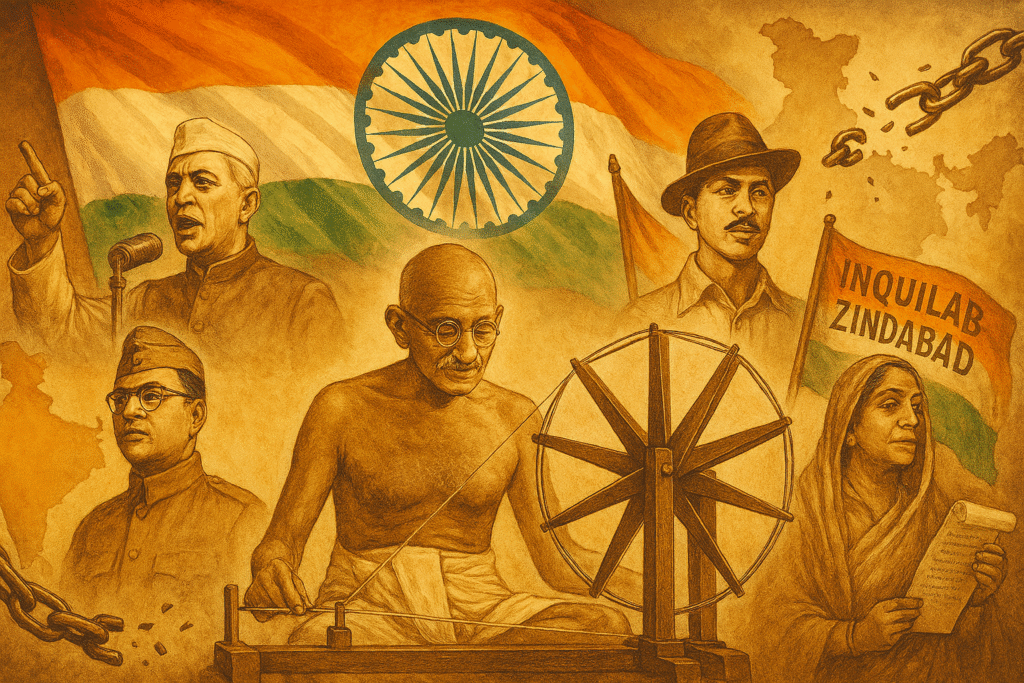
To speak of India Independence Day without speaking of those great visionaries who brought it to fruition is impossible. Narratives of India Independence Day mostly revolve around Mahatma Gandhi among many others; he happens to be the soul of such narratives. Practicing and preaching ahimsa (non-violence) and truth, his teachings have not only inspired the nation but also world over people like Martin Luther King Jr., and Nelson Mandela. On India Independence Day, his life is staged in plays and exhibitions at schools and communities all over the country, hence keeping his legacy alive.
Bhagat Singh, a young freedom fighter who was martyred at age 23 epitomizes that fiery youth who gave everything for the motherland’s sake. His fiery deeds must have been an inspiration to many others. The Iron Man of India, Sardar Vallabhbhai Patel post-independence brought together 500 odd princely states to make it a modern Indian Union ensuring that India Independence Day was indeed the birthday of a nation.
Sarojini Naidu, Nightingale of India, poet and politician, led protests while singing songs to inspire hearts. Women played an equally vital role in the path to India’s independence. The story of Rani Lakshmibai of Jhansi belongs to an earlier time but she is quintessential woman’s courage against invading forces – her tale recounted at India Independence Day parades. Heroes like these remind us that the India Independence Day triumph belongs to beating as one toward a shared purpose.
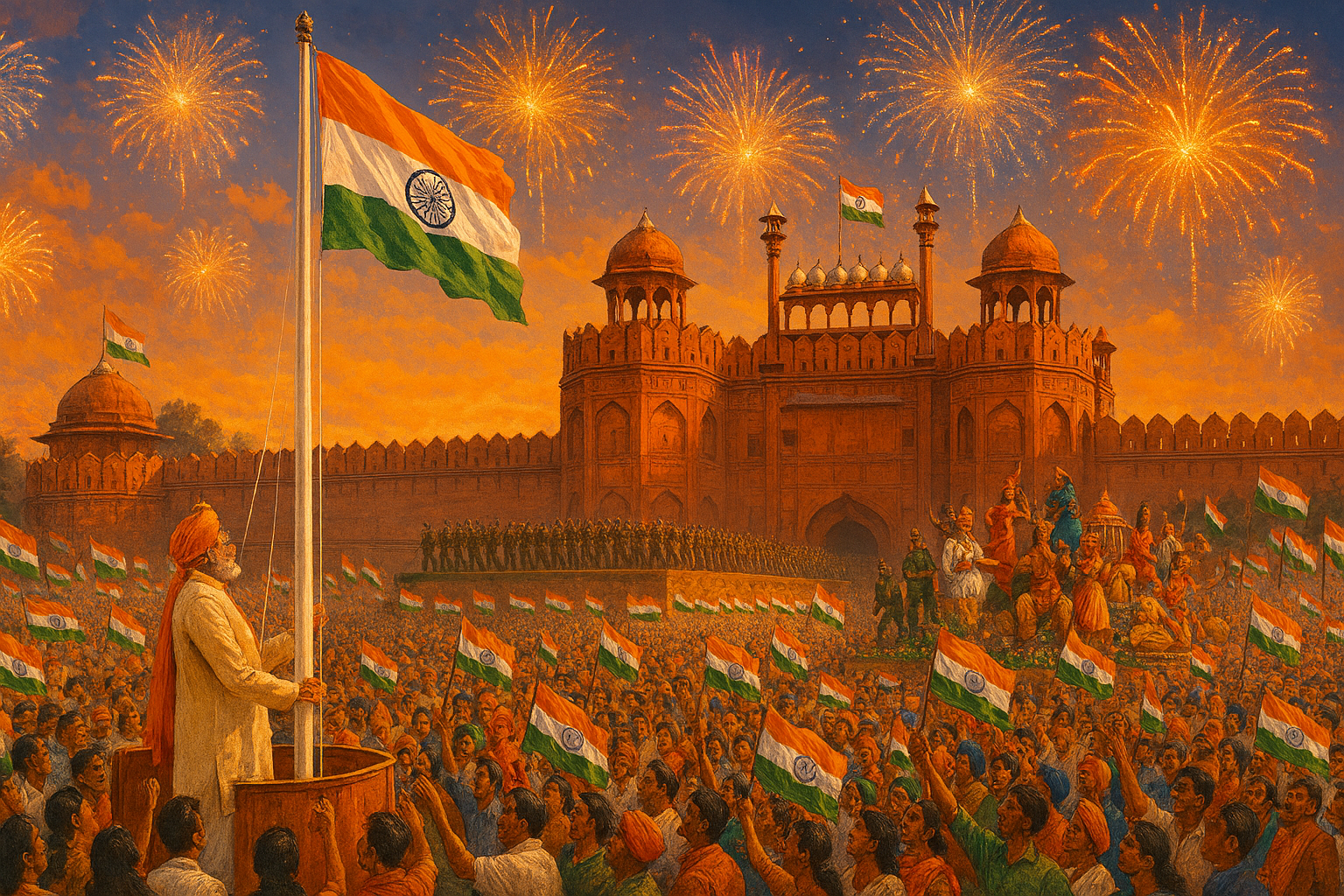
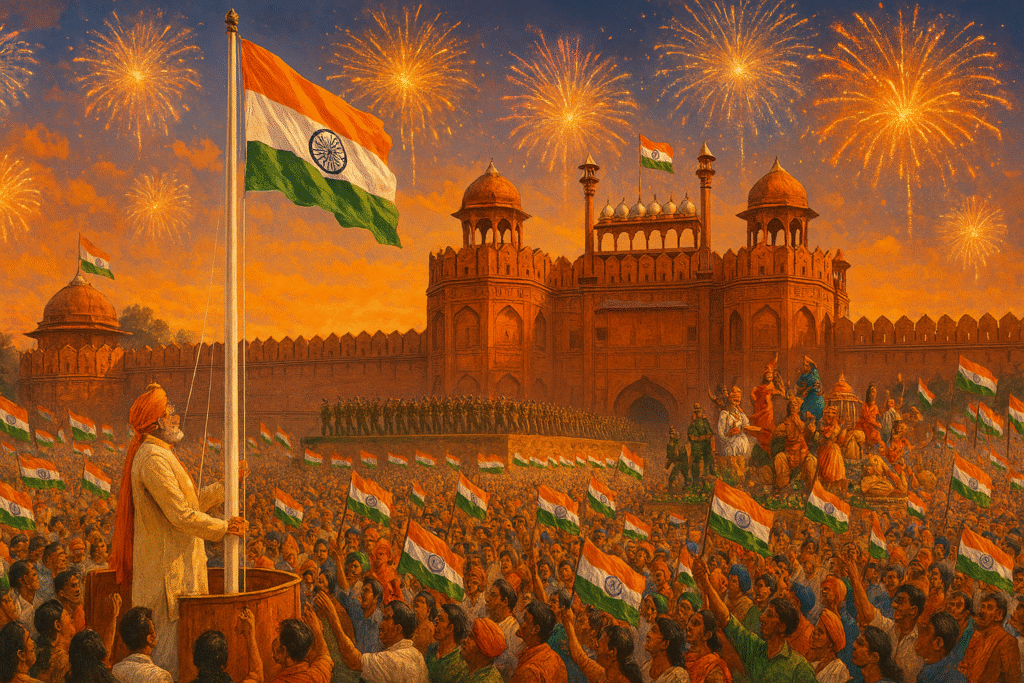
The show of patriotism, color, and unity comprise the Indian Independence Day. The Prime Minister hoists the national flag at Red Fort, Delhi with an address to the nation that should stir every soul. Nehru himself set this tradition in motion drawing direct parallels with the historic India Independence Day of 1947. It is then followed by a parade that displays military strength, cultural variety, and technological achievements with tableaux from different states presenting regional heritage.
Celebrations may differ across the country, but the threads of unity in India Independence Day are quite common. Flag hoisting, patriotic songs like ‘Vande Mataram,’ and dances on the theme of freedom struggle are common features in almost all schools. Kite flying assumes an added impetus towards gaiety in the message of freedom, especially in northern India where multicolored kites fill the skies. Families unite at particular meals which are often sweet-based laddoos and jalebis with a greeting salutation of Happy India Independence Day.
It’s been the last few years, and digital celebrations have skyrocketed for India Independence Day. You can find #IndiaIndependenceDay posts, online events, Red Fort ceremony live streams, you name it. Proof that the celebration of India Independence Day travels the world comes from expatriate Indians organizing events from Times Square in New York to Trafalgar Square in London. The year 2015 will be the year when Indian Independence Day celebrations are sustained by sustainable development and innovation; hence, the theme is likely to be ‘Viksit Bharat’ (Developed India).
Inertia of the fast-moving world today matters why does India Independence Day still matter. Forget the nostalgia part; more importantly, it is a call to action. Values that India Independence Day remind one of the constitution, justice, liberty, equality, and fraternity. Struggles such as economic inequality, climate change, and social divisions have made it hard for the country; at the same time, India Independence Day makes us recommit to these ideals.
Economically speaking, India has transformed from that first India Independence Day. From a poverty-stricken nation to the world’s fifth-largest economy, indeed it is remarkable progress. Make in India, and Digital India speak of self-reliance initiatives echoing the same preached by Gandhi. On India Independence Day 2025 when we celebrate 78 years of freedom, talking about AI and space exploration (with Chandrayaan missions) and renewable energy puts forth India’s global stature.
Socially, it inspires the principle of unity in diversity. Among more than 1.4 billion people speaking hundreds of languages and belonging to different religious practices, this day reminds us that inclusivity is our strength. It is around India Independence Day that such campaigns attain momentum, drawing inspiration from the very essence of the freedom struggle. Campaigns against caste discrimination and gender inequality are mostly conducted.
Also, this day is a learning tool. Jails like the Cellular Jail in Andaman where freedom fighters were kept show special exhibits. Films and books on India Independence Day help kids learn about unknown heroes, making sure the feeling of love for the country stays strong.
The day is merry, but it is a day of reflection. The wounds of partition live on in the border conflicts and issues of communal harmony. The economic differentials have not waned; rural-urban gaps continue to spur on the dream of equitable growth. These are thus days when leaders talk about them and promise better plans on education, healthcare, and employment.
Environmental considerations are an overlay. As India pushes the world for development, balancing it with sustainability is crucial. Green initiatives — afforestation drives or clean energy pledges — could be spotlighted by India Independence Day 2025, aligning freedom with planetary responsibility.
India Independence Day inspires nations across the globe who are yet under the yoke of oppression. From Myanmar to Afghanistan echoes of India’s non-violent struggle resound. As a G20 leader, India’s relevance in international affairs advocating peace and multilateralism emanates from principles born on India Independence Day.
The personal stories that interlace the whole of India Independence Day make it truly humane. Every August 15, my grandfather – a partition survivor – would share stories of loss and resilience. He would have been through those midnight celebrations in 1947 – fireworks, slogans, tears of joy and sorrow. Such anecdotes humanize India Independence Day; they turn history from just something known into lived experience.
Today, the young Indians of today add their own spin. A student in Mumbai may volunteer at a blood donation camp on India Independence Day while a techie entrepreneur in Bangalore launches an app for local artisans. These are acts that embody the spirit of: it is not just political freedom but personal empowerment.
India Independence Day, therefore, celebrates cultural richness too. “Gandhi” or “Lagaan” Bollywood movies revisit the period; so does the literature, from Rabindranath Tagore’s poems to Arundhati Roy’s essays, in its every nuance. A.R. Rahman’s patriotic anthems and folk songs are just some of the forms of music that move people on India Independence Day.
As this reflection over India Independence Day draws to a close, let us look into the future. By 2047—that will mark hundred years of independence—India shall have achieved development. That day would be more than mere reminiscence of past glories; it would celebrate an accomplished vision, where poverty has been eliminated and education for all is a reality with unbounded innovation.
It really makes India Independence Day a walker between the sorrows of yesterday and the hopes for tomorrow. Everyone will realize that freedom indeed is very fragile and that it requires being watchful and playing one’s part. So, let us in this India Independence Day 2025 hoist high the tricolor, sing the anthem with fervor, and commit to building a better India.
Happy India Independence Day to all! May the spirit of freedom guide us always.