
Meta: Why do Uber fares and grocery bills keep rising? Look to the oil markets for answers.
You see, oil prices don’t just affect the petrol pump… they secretly rub off on India’s entire economy. And most people don’t know that every ₹1 increase in crude oil directly impacts your wallet in ways you’ve never imagined.
The Hidden Web: How Oil Prices Reach Every Corner of Your Life.
Let me paint you a picture. It’s Monday morning. Oil prices spike by $10 overnight in global markets.
Within 48 hours… your delivery costs go up. Food prices edge higher. The rupee weakens. Your mutual fund portfolio starts showing red. The RBI gets nervous about inflation. And suddenly, that EMI you were planning becomes more expensive.
Sounds dramatic? It’s not. It’s just Monday in oil-dependent India.
Here’s the reality: India imports over 85% of its crude oil needs. That’s like being completely dependent on your neighbor for your daily meals. When they decide to charge more, you pay more.
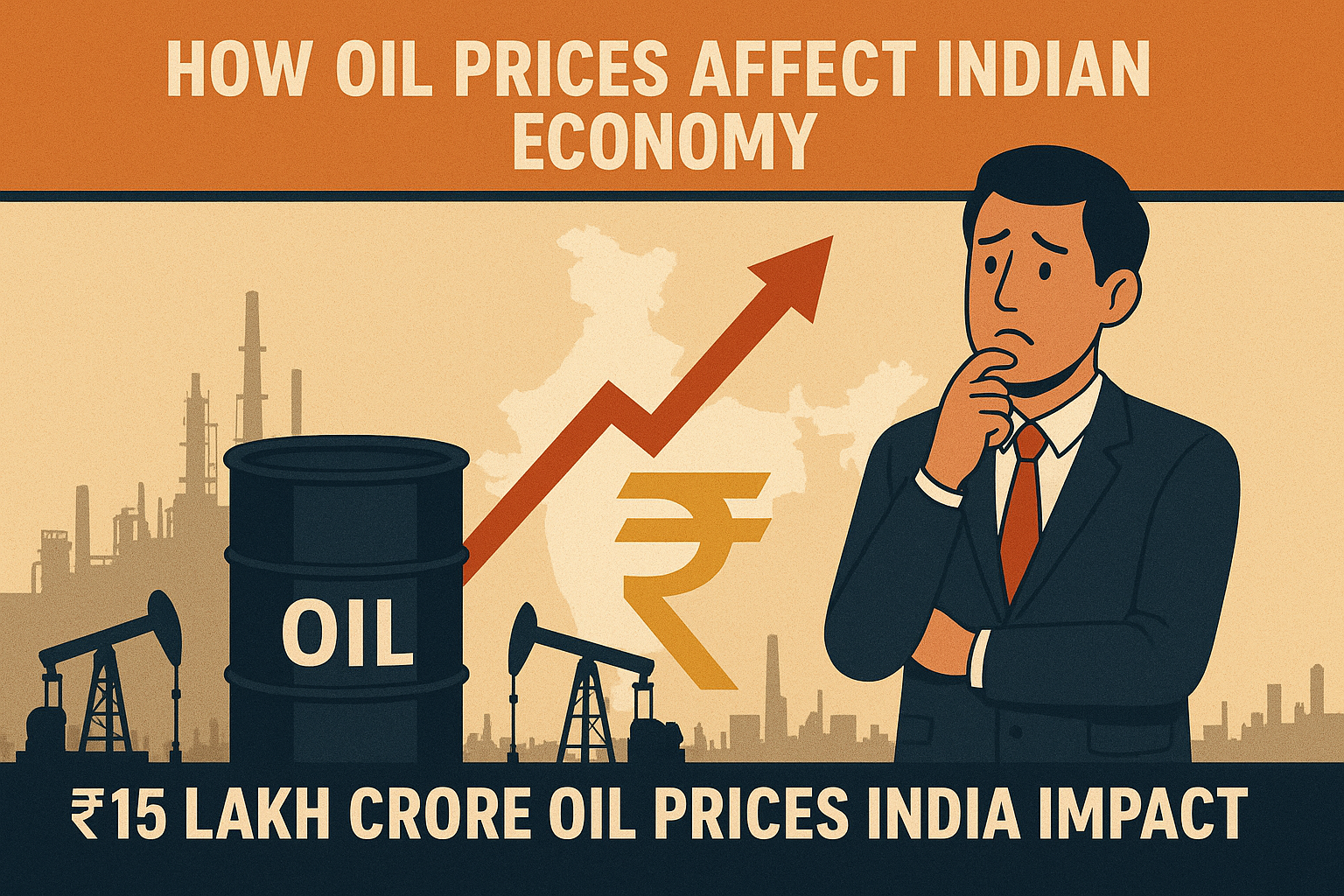
In FY24 alone, we spent approximately ₹15 lakh crores on crude oil imports. That’s nearly one-fourth of everything India imports combined. One commodity. One-fourth of our import bill.
Unseen Consequences in India
When oil prices rise, three things happen almost immediately:
1. Your Cost of Living Shoots Up (Even If You Don’t Own a Car)
Every item you buy travels to reach you. Every vegetable, every electronic item, every piece of clothing. Transport costs are baked into everything. When fuel costs rise, logistics companies pass it on. Retailers pass it on. And eventually… You pay for it.
If crude oil rises by ₹10, India can experience inflation by 0.5-0.7%. That might sound small, but on a ₹50,000 monthly budget, it means an extra ₹250-350 every month. Over a year? That’s ₹3,000-4,200 more for the same lifestyle.
2. The Rupee Gets Hammered
Every barrel of oil India buys costs dollars. Higher oil prices = More dollars needed = Rupee falls. When the rupee falls, everything imported becomes expensive. Electronics, medicines, raw materials… the works.
It’s a vicious cycle. Expensive crude oil weakens the rupee.

3. The Stock Market Goes Into Panic Mode
A hike in the price of oil can stagnate most economic sectors. Some gain while some lose.
Losers: airlines, FMCG companies, the auto sector, and paint and chemical companies
Winners: Oil exploration companies like ONGC and some refiners.
Smart investors watch oil prices like hawks. Because they know what happens to crude today shows up in corporate earnings next quarter.
The Government’s Unattainable Choice
When oil prices surge, the government faces a brutal dilemma.
Option 1: When they intend to cut fuel taxes for less revenue. A higher fiscal deficit springs up.
Option 2: Let’s increase prices. Inflation backlash and economic slowdown show up.
Option 3: They increase subsidies. And we find ourselves in fiscal deficit balloons.
There’s no clean way out. And guess who ultimately pays? The taxpayer. Always.
The ₹15 Lakh Crore Question: Impact on India’s Growth
Here’s something that will shock you: A sustained $10 increase in crude oil can shave off 0.25-0.27% from India’s GDP growth.
If India was supposed to grow at 7% this year, expensive oil could bring it down to 6.7%. That’s enough to change everything… slower job opportunities, few corporate benefits, lower stock market returns, an undervalued rupee, and higher interest rates.
Sector Winners & Losers
When oil prices are rising:
- Avoid airlines, logistics, and paint companies.
- Consider oil exploration stocks.
- Look at defensive sectors like pharma and IT.
When oil prices are falling:
- Jump into transport, aviation, and auto stocks.
- Consumer goods companies become attractive.
- Infrastructure gets a boost.
The point is that oil prices often signal sector rotation 2-3 months before earnings reflect the impact.
Oil Price Cycle Secret
The pattern 99% of investors never realize:
Phase 1: Oil prices rise unexpectedly.
Phase 2: Markets panic while the rupee falls.
Phase 3: The Government devises measures
Phase 4: Markets stabilize.
Phase 5: Cycle repeats
The investors who consistently win? They position themselves in Phase 1 for Phase 4 opportunities. Most people react in Phase 2 or 3… when it’s already too late.
India’s Freedom Plan
India isn’t sitting idle. Current measures include:
- Strategic Petroleum Reserves 9.5-day buffer
- Ethanol blending targets 20% by 2025
- Aggressive EV and renewable push
- Diversifying import sources
Guide yourself with these investment strategies:
Investment Strategy:
- Keep 10-15% portfolio allocation to energy stocks.
- Keep exposure to defensive areas such as IT and pharma.
- Try commodity-linked mutual funds.
Insurance Plan:
- Have a 6-12 month emergency fund.
- Channel oil price risks into major decisions.
- Consider fuel-efficient vehicles.
Timing Strategy:
- Watch oil price cycles for big expenses.
- Use oil price drops as spending opportunities.
What’s Next?
Potential Threats: Middle East agitations, OPEC cuts, China’s growth revival
Bright Sides: US oil output, buffer supplies, recession risk
My Outlook: Oil prices will remain volatile, with ₹75-95 per liter of petrol being the new normal.
Final Note
Oil prices aren’t just about fuel costs. They’re about India’s growth projection. Your investment returns. Inflation in your grocery basket. The rupee in your pocket.
Understanding the connection will lead to success.
✓ You’ll know the market movements before others.
✓ You’ll make better investment decisions. ✓ You’ll plan finances around economic cycles. ✓ You’ll protect wealth from inflation.
Most financial advisers won’t tell you this: In India, oil prices are the single biggest external factor affecting your financial future.
Ignore them at your own risk.